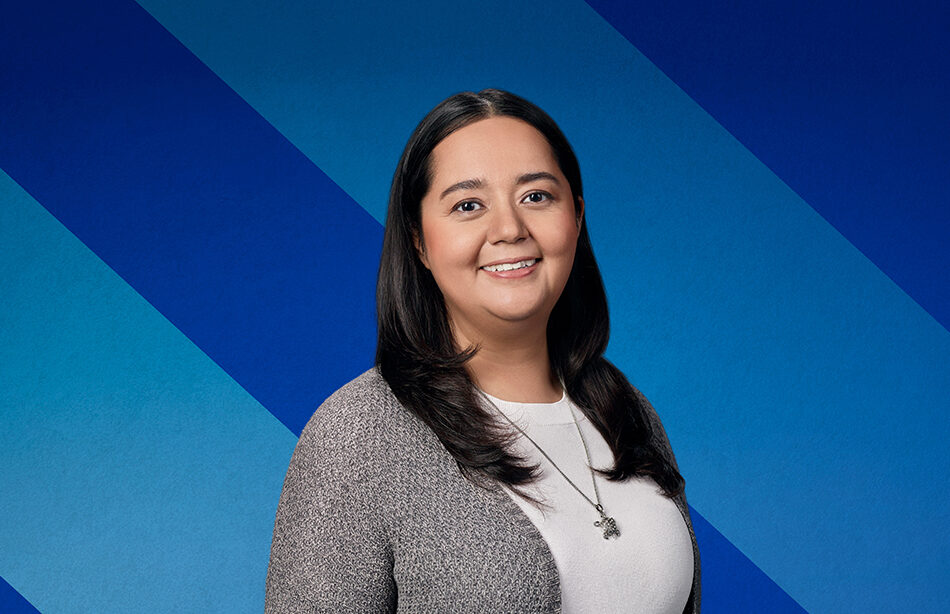
Dzin guzun. Sid Dr. Johanna Sam sets’edinh. Sid Tŝilhqot’in xaghiyah. Sid Musqueam nen ŝidah as. Good day, Dr. Johanna Sam is a citizen of the Tŝilhqot’in Nation and currently resides on the ancestral and unceded territory of the Musqueam People.
Dr. Johanna Sam is an Associate Professor in the Faculty of Education at the University of British Columbia, a faculty member of NITEP – Indigenous Teacher Education Program and the Human Early Learning Partnership (HELP), and a Michael Smith Health Research BC Scholar.
She explores the everyday conditions that shape youth holistic wellbeing, from experiences in online life and education to the broader impacts of climate change, bringing Indigenous peoples’ worldviews to inform research, policy, and practice.
Focus on community-led research
Throughout her career, Johanna has focused on community-led research and co-creating solutions for adolescent mental health promotion.
She is passionate about what a community feels there is a need for, with a real focus on theory to practice – that research outcomes should create positive change among diverse young people and their families in the community.
Johanna is involved in several community-based projects, including one on identifying Indigenous community-led solutions to public health emergencies (pandemics and climate change). Tl’etinqox community of the Tŝilhqot’in Nation invited her into the public health emergencies and community solutions project, working with health researchers Drs. Darlene Sanderson (University of Northern British Columbia) and Noeman Mirza (University of Windsor).1
The study presented a strengths-based Indigenous approach led entirely by Tl’etinqox community-based researchers – made up of intergenerational members, from youth to Elders.
“This research was led by Tl’etinqox knowledge holders and guided by Tŝilhqot’in language, teachings, practices, and relationships with the land and water,” says Johanna. “By placing community knowledge and leadership at the centre, the study honours Indigenous ways of knowing and asserts their right to lead research that affects their health. It demonstrates how strengths-based, Indigenous-led approaches can shape more socially just and culturally grounded responses to public health emergencies.”
Building on their work in the community, the group has formed the not-for-profit YADANX GHATAGWEDIT’ALH Society (Holding Up Our Past and Ancestors) to establish a Tl’etinqox-led sovereign research centre.
“Often, universities control research funding, even when the work is meant to benefit Indigenous communities,” says Johanna. “Through the not-for-profit society, Tl’etinqox community members can manage grants themselves, decide what research happens, and guide how it benefits their community, thereby putting Indigenous voices and leadership at the heart of the work.”
A sovereign research centre will help build capacity for the community to conduct research and ensure findings are effectively shared, understood, and applied. This approach is grounded in the 4Rs of relationality of working in partnership with Indigenous Knowledge Keepers, respect for oral protocols, relevance to the local traditional land and waters, and reciprocity of translating study findings into Indigenous languages and sharing knowledge on the land.
Diverse youth voices in digital and health equity research
At the Yatu Lab (based at UBC’s Faculty of Education), Johanna leads a program of research exploring how young people, from early childhood to young adulthood, navigate digital life, including experiences of cyber aggression, holistic wellbeing, and resilience. Her work combines quantitative and qualitative methods, linking surveys, and statistical analyses with Sharing Circles, interviews, and digital storytelling, to capture both patterns and the lived experiences behind them.
“Numbers can show us patterns, but they cannot tell the whole story,” says Johanna. “By centering youth voices, listening deeply, and combining lived experience with mixed methods, we produce research that not only advances knowledge but drives meaningful change. I hope health researchers consider how centring diverse youth perspectives can transform the questions we ask, the methods we use, and the solutions we develop.”
A central focus of the lab is equity, diversity, inclusion, and decolonialization. Johanna’s team prioritizes approaches that amplify voices often overlooked in research, especially racialized and Indigenous youth. This includes her work on the Nini nanaghintsan ?anh (is your mind tired?) project. It examines health services access among urban Indigenous youth, ensuring research directly informs policies and practices that reduce inequities within integrated youth services.
Indigenous ways of knowing
For Johanna, it is critical that Indigenous ways of knowing and culturally resurgent research methodologies are included in this approach.
“I see myself as a story protector,” Johanna says. “In Indigenous communities, research has often caused harm — knowledge has been taken without respect or reciprocity. Being a story protector means I have a responsibility to care for the knowledge shared with me, to ensure it is used in ways that benefit the community. I gather stories through healing circles, oral histories, and self-reported surveys, but always with care, listening deeply, and creating space for youth to speak for themselves. My research is about honouring voices, protecting stories, and returning knowledge to the community.”
With the Tl’etinqox community-based research team, Johanna is engaging in innovative projects at the intersection of climate change and wellness. Together, they are developing approaches that bring together traditional Indigenous knowledges with research methods.
“Our work is characterized by a deep respect for Indigenous ways of knowing and a commitment to co-creating solutions that promote environmental sustainability and holistic well-being,” says Johanna. “Through our collaborative efforts, we aim to generate insights and strategies that are culturally grounded, community-driven, and forward-thinking, ultimately contributing to the resilience and thriving of Indigenous communities in the face of environmental change.”
Strengths-based approach
A core principle of Johanna’s work is a strengths-based approach focusing on Indigenous knowledges, traditions, and resilience that already exist within communities. “Research is most powerful when it centres the voices of those it seeks to serve,” she says. “By walking alongside youth and communities, listening deeply, and combining their lived experiences with research methods, we can generate insights that not only advance knowledge but also drive meaningful, equitable change. I hope other researchers and practitioners will join in creating spaces where young people’s voices guide the work, shaping policies, programs, and interventions that truly respond to their needs.”
Learn more about Johanna SamStay informed
Subscribe to our newsletter and follow us on LinkedIn and Bluesky.
1 Strength-Based Indigenous Public Health Emergencies Research: Tl’etinqox Methodology, International Journal of Indigenous Health: https://jps.library.utoronto.ca/index.php/ijih/article/view/43194