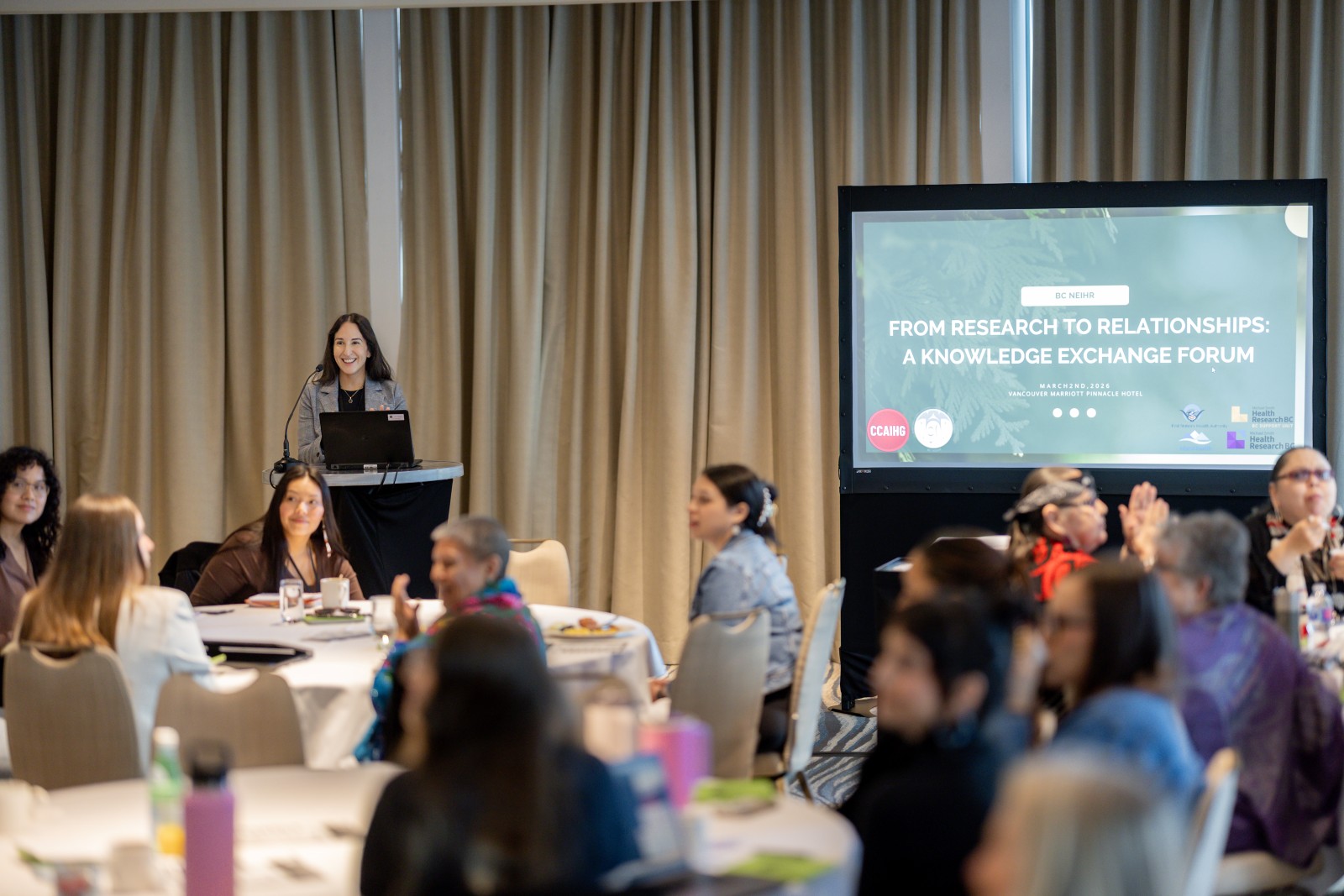
The Knowledge Exchange Forum: From Research to Relationships brought people together to hear how Indigenous scholars are using Indigenous methodology, connection to community, and academic expertise to conduct research with impact.
Hosted by the BC Network Environment for Indigenous Health Research (BC NEIHR) on the unceded,
ancestral territories of the xʷməθkʷəy̓əm (Musqueam), Sḵwx̱wú7mesh (Squamish), and səlilwətaɬ (Tsleil-Waututh) Nations, with support from BC SUPPORT Unit, part of Michael Smith Health Research BC, the March 2 event gave a platform to the 2025 BC NEIHR fellowship and scholarship recipients to share their projects.
Keynote speaker Dr. Sdahl Ḵ’awaas (Lucy Bell), Haida scholar and BC NEIHR post-doctoral fellow, was the first to share her work on repatriating Haida remains and belongings from museums. To date, she has helped bring home hundreds of ancestors from museums across North America and in the United Kingdom.
Her dissertation, Tla Yahda – Haida Museology Makes Things Right (PDF), published in 2025, reflects the Haida principle of tla yahda – to make things right. Each chapter begins with a letter to her daughter, and the document incorporates Haida language throughout. She defended her dissertation in Tluu Xaada Naay longhouse, turning the event into a community celebration.
“Bend the academic box and fill it with your own tools,” she said. “You’re in a relationship with your research – make sure you love it.”
BC NEIHR-supported students who are completing PhD and Master’s Degrees shared what drew them to their research focus areas and the progress they’ve made.
The lived experiences of formerly incarcerated Two-Spirit and Indigiqueer people
Andrew Caldwell, an Anishinaabe person and PhD candidate at Simon Fraser University, is exploring the experiences of Two-Spirit and Indigiqueer individuals who have previously been incarcerated in correctional facilities. The study’s goals are: to influence policy changes and correctional reform for better outcomes for incarcerated kin; to address health disparities; and to better understand how Elders and Knowledge Keepers can support Two-Spirit and Indigiqueer people who are incarcerated.
Healing through ceremony
Sara Daigle-Stevens is exploring First Nations wellness practices, bringing her authentic, personal journey to academic research by looking at ceremony as a tool for healing. Sara is Ktunaxa, Liğʷiłdaxʷ, and X̱aayda, and works as an Addictions Specialist with the First Nations Health Authority helping people to be whole and happy. She is pursuing a Master of Science in Nursing at the University of British Columbia.
Place-based addiction recovery care
Cecilia Raweater, who is Sto:lo and Blackfoot, grew up in the Siksika Nation in southern Alberta and is completing her master’s degree at the University of British Columbia. Inspired by a resurgence of culturally grounded healing in her home community, Cecilia is interested in ways of connecting to place and peoples, and having the ability to access addictions supports without leaving one’s community, as methods of re-imagining recovery.
Culturally safe end-of-life care
Ashley Hubbard, of the Kwanlin Dün First Nation near Whitehorse, and Emma Tetrault, who is Métis, are looking at how to improve end-of-life care for Indigenous peoples. Ashley noted that often, “end of life is not about dying, it’s about staying – making sure no one crosses alone.” They are engaging a “co-relational thesis” model for their Master of Science in Nursing at the University of British Columbia Okanagan, focusing on the collective aspect of caregiving and relational understandings of death. By engaging with members of Kwanlin Dün First Nation and the Kelowna Métis community, they are sharing the desire for relational and collective care and are looking for ways to make space for such work in healthcare.
Improving comfortable healthcare for children
Hannah Nelson is Liǧʷiłdaxʷ from the We Wai Kai Nation on Vancouver Island. As part of her Master of Science degree at the University of British Columbia, she looked at swabs used to test children for respiratory viruses at BC Children’s Hospital. Hannah noted that the standard deep nose (nasopharyngeal) swabs can be painful and scary for children, creating negative experiences of healthcare early on. Her research asked whether less-invasive combined nose-throat (oropharyngeal nasal) swabs, collected by a parent or caregiver, could be easier for children and still accurate. The answer: yes. Hannah’s collaborative research was published in Microbiology Spectrum, an academic journal that shares research studies of high technical quality that are useful to the community. Additionally, the nose-throat swabs are now offered at BC Children’s Hospital as a routine sample collection option for respiratory testing.
Closing words of guidance
Namaste Marsden shared reflections on Indigenous leadership and service in research to help close the day. Namaste is from Gitanyow, belonging to the Wilp Gamlaxyeltxw of Lax Ganeda (Frog Clan), and is a member of BC NEIHR’s Governing Council and the Health Research BC Board of Directors. She encouraged Indigenous students and scholars to continue grounding their relationships to the academy and research in their culture, language, identity, and authority of their nations, adding that their Indigenous perspectives are vital to the future of health research and this work is for future generations.
Summary
Forum attendees learned from each other’s journeys and strengthened connections to sustain Indigenous health research. Each student brought their own relationality to their work, pushing health research forward with methodologies from their communities and Nations.
“The research shared through this forum reflects the strength, innovation, and leadership of Indigenous students and scholars across British Columbia who are advancing research grounded in relationships, community priorities, and Indigenous knowledge systems,” said Dr. Krista Stelkia, who leads BC NEIHR. “Through BC NEIHR, we are supporting the next generation of Indigenous scholars who are reshaping health research systems in ways that uphold self-determination, relationality, and community impact.”
BC NEIHR, hosted at the Centre for Collaborative Action on Indigenous Health Governance in the Faculty of Health Sciences at Simon Fraser University, supports Indigenous-led health research by creating funding pathways that uphold Indigenous values, principles, knowledge systems, and research approaches. Every year, it supports a cohort of graduate and post-doctoral students in British Columbia through its scholarship and fellowship opportunities.
Health Research BC partners with BC NEIHR to support Indigenous-led research that catalyzes solutions to health system challenges. The partnership aims to elevate Indigenous voices in health research.
If you are interested in applying for a BC NEIHR Scholarship, visit their website to learn more.
Learn more about BC NEIHR ScholarshipsStay informed
Subscribe to our newsletter and follow us on LinkedIn and Bluesky.