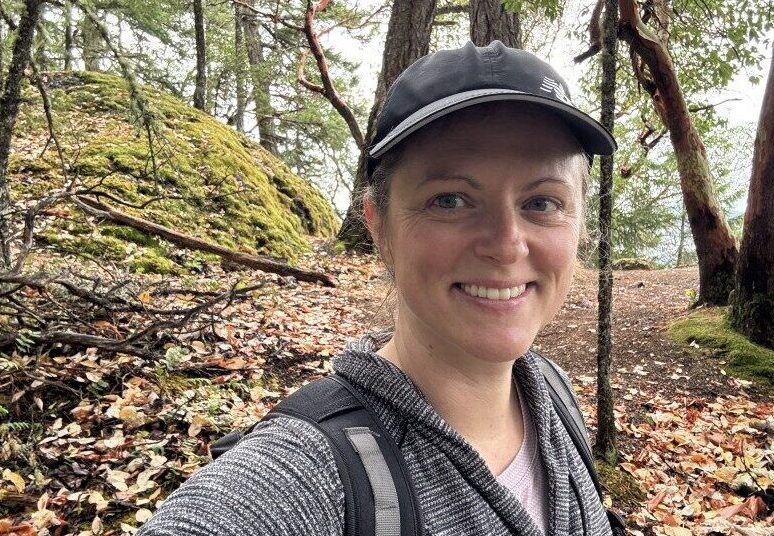
Photo: Dr. Jean Buckler hikes Mount Erskine on Salt Spring Island, remembering childhood summers exploring BC parks.
Dr. Jean Buckler has always had a strong connection to nature. Growing up in British Columbia, she spent summers camping and exploring BC’s provincial parks. Her family regularly hiked in and around south Vancouver Island, including PKOLS, East Sooke Park, and Lone Tree Hill.
As a young researcher, Jean worked at a community pool and fitness centre in Victoria. She saw first-hand how barriers to accessing health-promoting activities could affect families. The experience helped shape her interest in finding ways to make healthy choices more accessible.
Today, Jean’s research at the University of Victoria focuses on systems-level changes that can make it easier for people to adopt healthy behaviours, such as being more physically active, spending less time on screens, and getting more sleep.
“Social determinants of health play a major role in people’s ability to make healthy choices. We need to look at the systems around people — from policies and community programs to the environments where they live — and find ways to make healthy choices easier for people,” says Jean. “We’re looking at how we can create broader supports that give everyone a better opportunity to engage in healthy behaviours.”
Bringing nature and healthcare together
Research has shown that spending time in nature can benefit both physical and mental health. Just 20 minutes outdoors can significantly lower levels of cortisol, the body’s primary stress hormone. Cortisol helps the body respond to acute stress, but chronically high levels can contribute to weight gain, disrupted sleep, high blood sugar, high blood pressure, and anxiety.
“When people are outside in nature, they’re more likely to do more physical activity and may exercise more intensely without necessarily intending to,” Jean says. “And it feels less difficult because they’re in an enjoyable setting.”
Jean’s research interests led her to partner with BC Parks Foundation on a unique nature program, Park Prescriptions (PaRx).
Developed by BC Parks Foundation, PaRx is Canada’s first evidence-based nature prescription program. It equips healthcare providers to prescribe time in nature to their patients to support their physical and mental health. Providers receive practical tools, including prescription templates, patient handouts, and guidance on prescribing and tracking nature prescriptions.
PaRX also partners with nature-forward and mobility organizations across Canada to reduce barriers to accessing natural spaces. These include national parks, botanical gardens, car and bike share services, and nature-rich art galleries and museums.
John Shaske knows the value of PaRx. He says two years ago, he was constantly working, checking his emails, focusing on getting his job done, not taking time to slow down and relax. Then through PaRx, his pharmacist prescribed time in nature and gave him access to a Parks Canada pass to help reduce stress and improve his mental health.
“I cycle, walk, have picnics, and I’m learning more about nature — the birds, flowers, trees,” says John. “We’re in a mode of society where people forget what’s important. Nature has been a reset for me. I’ve learned that reviewing the latest emails is less important than going to the next meeting on time without rushing. This program can help people focus less on irrelevant things, be more relaxed, and be happier.”
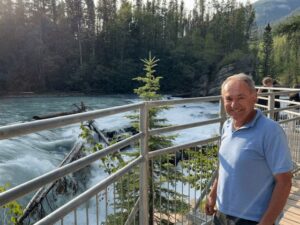
Photo: John Shaske enjoys Rearguard Falls Provincial Park on the Fraser River. He says spending time in nature has helped reset his priorities.
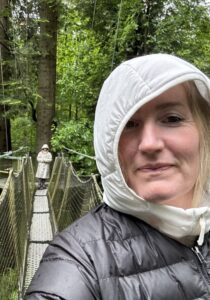
Photo: Jennie McCaffrey doesn’t let the rain stop her (or her family!) from doing the treetop forest walk at UBC Botanical Gardens.
“Our goal is a cultural shift towards spending time outside every day,” says Jennie McCaffrey from BC Parks Foundation. “In the same way that you brush your teeth or put on a seatbelt in the car, we want spending time outside to become a social norm — a regular part of people’s daily lives.”
PaRx numbers (so far)
21,000+ prescribers across Canada:
- Physicians: 41%
- Nurses: 32%
- Allied health professionals: 21%
- Other providers: 6%
2.1 million nature prescriptions
Making nature prescriptions more accessible
When PaRx launched, it quickly gained momentum, scaling up to every province in under two years. But while the program was based on research evidence, the program itself needed to be evaluated for its reach, usability, and effectiveness.
Supported by Health Research BC funding, Jean led an interdisciplinary research team — with expertise in physical activity, mental health, psychology, education, neuroscience, and physiology — to develop an evaluation strategy focused on making PaRx more accessible.
They interviewed healthcare providers registered with PaRx to understand how the program was being implemented, what made it easy to use, and what barriers they encountered.
“We found that lack of transportation to access nature was a key barrier for patients, who may also struggle to afford activities that help them get outdoors,” says Dr. Melissa Lem, a Vancouver family physician who co-founded PaRx and was part of the research project. “Healthcare providers whose patients don’t have ready access to local green spaces tend to prescribe nature less.”
The team also found that many healthcare providers were unaware of patient discounts available through PaRx partnerships, including car share services and park admissions.
Based on these findings, Jean’s team developed recommendations for BC Parks Foundation. They included increasing awareness of existing partnerships, creating new ones, improving PaRx’s digital tools, and promoting the program more widely.
“We wanted to find ways to make it easier for healthcare providers to use PaRx, so that they’re accessing the program more often for more patients,” says Jean. “If more healthcare providers recommend time in nature, and patients spend more time in nature, we’re going to see a healthier community.”
BC Parks Foundation put all the recommendations into action. One result was a new partnership with AllTrails, an app with maps and trail guides for outdoor activities. Healthcare providers and patients using PaRx can access free AllTrails memberships. The app can help them find nearby places to spend time in nature, making it easier for patients to follow their prescriptions.
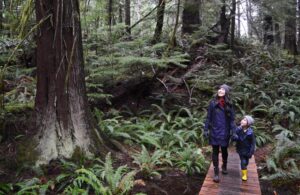
Photo: Dr. Melissa Lem and her son take in the sight of old growth trees in Kw’as Park on Cortes Island.
“When people get outside for their health, they’re more connected to nature and engage in more pro-environmental behaviors to protect nature,” says Jennie. “It’s a perfect circle for BC Parks Foundation. We need nature, and nature needs us.”
By integrating nature into routine healthcare, PaRx helps people build healthier habits, improve their wellbeing, and reconnect with the natural world — one prescription at a time.
From research to real-world change
The collaboration between the University of Victoria and BC Parks Foundation has shown how partnering with organizations already doing the work can help turn research findings into action. While the path from research to practice can be long, BC Parks Foundation was able to put the team’s recommendations into action quickly.
“Because we’re a nonprofit organization, we’re nimble, flexible and can implement changes immediately,” says Jennie.
“It’s important to partner with organizations that are already doing the work,” says Jean. “Together, we can create real-world change.”
The collaboration on PaRx led to another partnership around Learning by Nature, a new BC Parks Foundation initiative. BC Parks Foundation is working with school districts across BC to transform school grounds into nature parks — green spaces designed to support student well-being, increase biodiversity, and provide opportunities for outdoor learning. Students will learn about climate change, biodiversity, and the health benefits of nature. Jean’s research team is conducting a pre- and post-evaluation of the health, wellbeing, and educational impacts of the nature parks.
“What’s unique about the work we’re doing together is that while we’re collaborating, the research is being conducted independently,” says Jean. “This will provide BC Parks Foundation with an objective evaluation of what is happening.”
“I’ve learned just how powerful research can be in terms of driving change,” says Jennie. “It’s wonderful when we as a nonprofit can support and collaborate with researchers. These kinds of collaborations are how we create change. It’s exciting to see policy and practice come to life.”
Learn more

Dr. Jean Buckler is Associate Professor in the School of Exercise Science, Physical, and Health Education at the University of Victoria. She is also a Research Fellow at the Institute on Aging and Lifelong Health.

jennie mccaffrey
Jennie McCaffrey is Vice President, Strategic Engagement in Nature, Health, and Learning at BC Parks Foundation, a non-profit organization on a mission to create the greatest system of parks and Indigenous protected areas in the world.

melissa lem
Dr. Melissa Lem is a Vancouver family physician and co-founder of PaRx. She is also Past President of the Canadian Association of Physicians for the Environment (CAPE) and a Clinical Assistant Professor in the Faculty of Medicine at the University of British Columbia.
Stay informed
Subscribe to our newsletter and follow us on LinkedIn.