
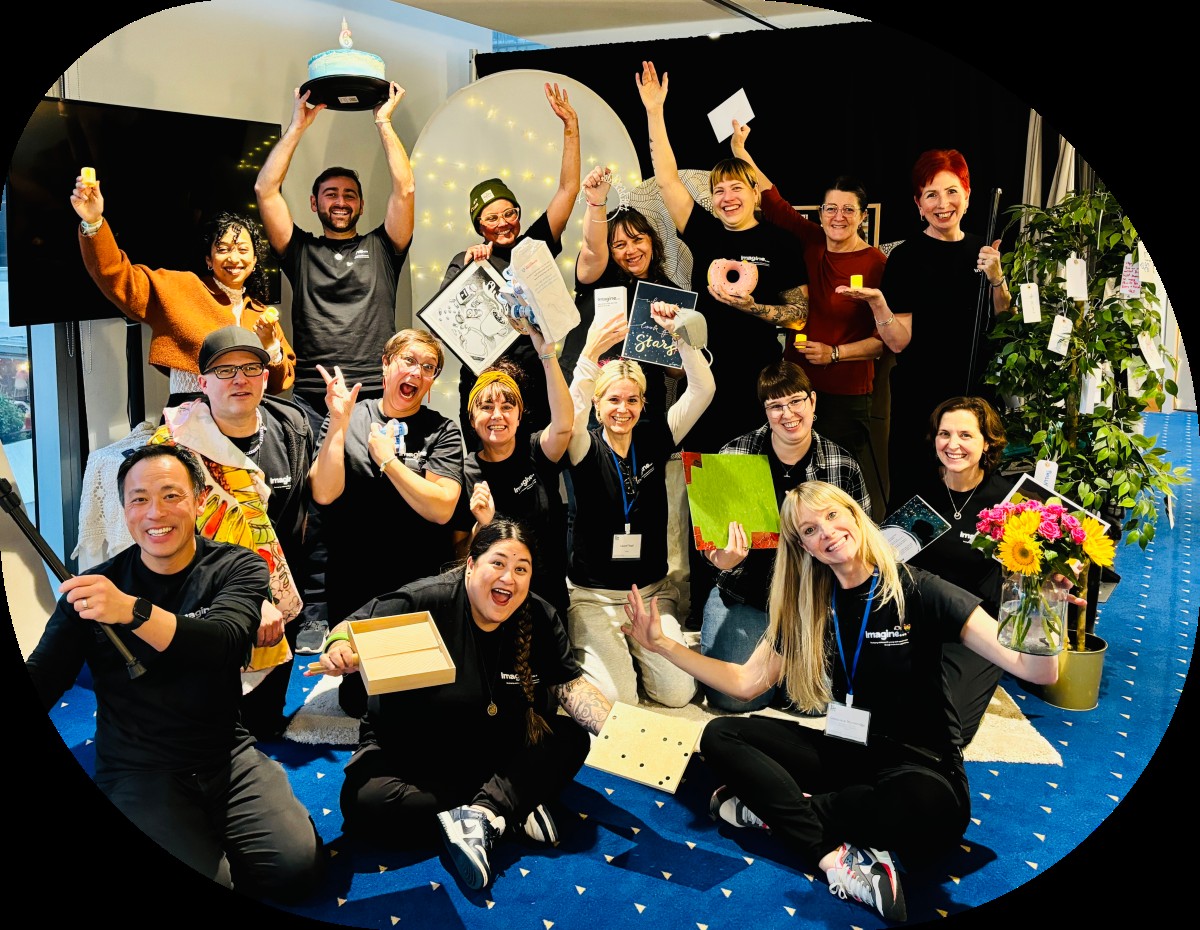
A photo of the Imagine team.
This casebook project is one of many featured in the lived experience in research road map resource, developed by the BC SUPPORT Unit. Explore the full set of case study examples.
Imagine…: Reshaping Adolescent and Young Adult Cancer Care Through Immersive Experience
Project team members include:
- Adolescents and Young Adult (AYA) Co-researchers: Ashley Tremblay, Jennifer L, Jodi Rethy, Jamie MacIver, Laura Floyd, Roxanne van Velzen, Shandy Bearman, Kaylie Rooke, Amber Baker, Stacey Brownell, Nellie Yee and Humera Jabir.
- Researchers: Cheryl Heykoop, Alice O’Grady, Tiffany Hill, Kat Dornian and Jennifer Wolfe.
- Counsellors: Genevieve Stonebridge and Gary Lam.
What is this project about?
To build awareness about the distinct experiences and needs of adolescents and young adults (AYAs – people diagnosed with cancer between the ages of 15-39), we worked with AYAs to co-design and share an immersive theatre experience, Imagine…, that offered a sense of what it means to navigate cancer as an AYA.
Who did you partner with for your project?
We worked with a group of 12 AYA co-researchers and included the insights of over 100 AYAs. Care providers were audience members.
How did partners with lived experience contribute during key stages of your research project?
Research stage
Throughout the project
How we partnered
Over a one-year period, AYA co-researchers and the facilitation team met both in-person and virtually to create Imagine….
In these gatherings AYA co-researchers:
- Reviewed data from AYA-focused research.
- Identified the scope and focus of Imagine….
- Conceptualized and explored how to stage the elements of Imagine…
- Wrote the scripts, organized stage directions and lighting
- Built the set and props.
Team members also performed Imagine… for health leaders, clinicians, researchers and AYAs at the BC Cancer Summit in 2024.
What’s your advice for someone who wants to collaborate with partners with lived experience?
When working with patient partners on a co-designed project, provide a structure for the work together and support for the process. However, simultaneously provide unstructured time for patient partners to gather, process, and create.
When working with patient partners around difficult topics, provide free counselling support.
How can someone learn more about your project?
- Visit the project website: Anew Research Collaborative
Acknowledgments and thanks
Anew Research Collaborative and the University of Leeds led the project.
It was supported with funding by New Frontiers in Research Fund, Royal Roads University, Michael Smith Health Research BC, and the Canadian Partnership Against Cancer.
This work was supported by BC Cancer, AYAs, and our many project partners.
This project was collected as part of a casebook that demonstrates patient-oriented research in BC.
Explore the casebook