
This casebook project is one of many featured in the lived experience in research road map resource, developed by the BC SUPPORT Unit. Explore the full set of casebook projects.
Critical participatory action research with racialized adolescents and young adults with lived experiences of cancer
Project team members include:
- Principal Investigator: Cheryl Heykoop
- Team Members: Tiffany T. Hill, Ian R. Cooper, Rabi Qureshi, Vinesha Ramasamy, Nellie G. Yee, Param K. Gill, Ada J. Okonkwo-Dappa, Jennifer Wolfe
What is this project about?
In this 18-month participatory research project, we engaged 27 racialized adolescents and young adults (AYAs) with cancer in Canada. Drawing on creative and critical methodologies, our work examined structural racism in cancer care and highlighted AYAs’ needs for support, advocacy, community, and meaningful engagement to reimagine more equitable care systems and futures.
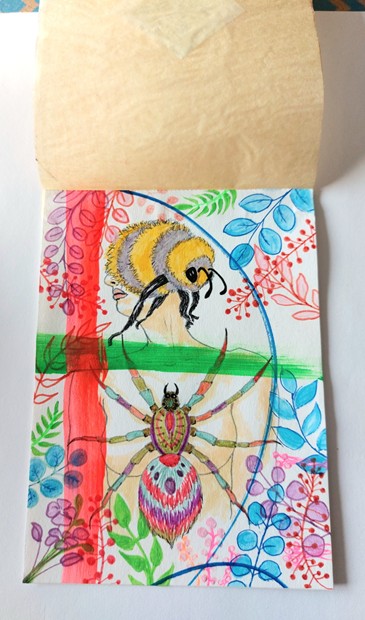
Below: Artwork created by adolescents and young adults with lived experiences of cancer, as part of the project. This piece is called: “To the surgeon charged with saving lives.”
Who did you partner with for your project?
We partnered with 27 AYAs who identified as racialized, had lived experience with cancer, and received treatment in Canada.
How did partners with lived experience contribute during key stages of your research project?
Research stage
Data analysis
How we partnered
Following an extensive multi-coder thematic analysis of 18 AYA interview transcripts, the project team identified five preliminary themes.
We then invited AYAs to participate in a creative, participatory analysis process to explore and expand on these themes in greater depth. Nine racialized AYAs participated in six weekly, facilitated two-hour sessions.
During these sessions, AYAs engaged in a range of creative activities including poetry, participatory photography, postcard and canvas making, free writing, and found poetry. Alongside these practices, AYAs participated in open discussions, building on each other’s ideas, making connections across their experiences, and contributing to shared meaning-making and co-theorizing.
Research stage
Knowledge translation
How we partnered
Over several months, three project team members and three racialized AYA partners co-authored a peer-reviewed journal article in Critical Race Inquiry. This process functioned as a model of participatory authorship, combining collective and independent writing supported by four 2-hour virtual sessions and ongoing email communication.
Early discussions focused on commitments, responsibilities, and shared approaches to co-authorship. Writing involved free writing and responses to prompts, guided by flexible timelines that accounted for AYAs’ lives and cancer experiences. AYAs identified access to shared resources, thematic summaries, and data as particularly sustaining, contributing to collaborative knowledge production and shared authorship throughout the process.
What’s your advice for someone who wants to collaborate with partners with lived experience?
When working with partners, we begin from a shared understanding of roles and expectations, while actively challenging internalized beliefs such as “I’m not good enough to write academic papers.”
Like any participatory process, this work requires balancing structure and flexibility to support meaningful engagement without over-determining how people contribute and participate.
How can someone learn more about your project?
Visit our website: Anew Research Collaborative
Read our journal articles:
- Learnings from racialized adolescents and young adults with lived experiences of cancer: “It’s okay to critique the system that claims to save us.”
- Imagining futures amidst the uncertainty of living: A critical participatory action research project with adolescents and young adults with lived experiences with cancer.
Acknowledgments and thanks
The project team would like to thank:
- Anew Research Collaborative
- Royal Roads University
- Canadian Institutes for Health Research
- Michael Smith Health Research BC
This project was collected as part of a casebook that demonstrates patient-oriented research in BC.
Explore the casebook