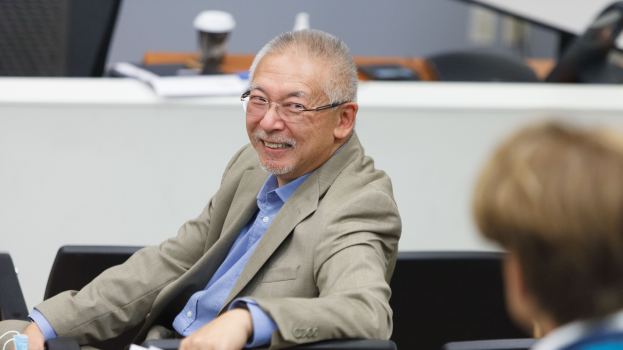
Retired pharmacist Sunny Loo, who lives with a rare form of vasculitis, is lending his voice to improve health research. He is someone with lived experience who works alongside health researchers to shape their investigative processes.
Sunny co-authored a commentary published in the medical journal BioMed Central Research Involvement and Engagement. Medical journals are how scientists, researchers, and medical professionals communicate their findings with others in the field and the public. It’s a step to sharing success that can be used elsewhere. Importantly, papers published in medical journals can also mean faster access to treatments that can make a difference.
Sunny shares how his transition from healthcare provider to recipient impacted him. Once, he participated in a research study but never had access to the results – prompting him to advocate for health research that better serves patients.
“Patients traditionally are passive participants in healthcare and health research. Patient-oriented research strives to change this,” Sunny says in the commentary. “By engaging with the BC SUPPORT Unit, I can contribute to patients achieving a more active role in their health.”
Read more about Sunny’s experience as a patient partner.
The commentary is part of a series of papers centering patient voices that include pieces authored by patients themselves. The series was coordinated by the BC SUPPORT Unit, a provincial initiative that helps move evidence developed with patients and communities into healthcare practice. Its goals include partnering with patients to improve healthcare, moving evidence into practice, and making health data easier to access.
The series is all about putting power in patients’ hands to improve their care.
Producing health research with impact
Having patient partners contribute to and author research that affects their health can lead to targeted, effective improvement of healthcare systems. That’s why the BC SUPPORT Unit champions patient partner involvement in research and care throughout BC. The series demonstrates how engaging patients can change lives on a provincial scale.
Dr. Linda Li, Scientific Director, BC SUPPORT Unit, thinks involving patients as co-designers of research is the most straightforward way to ensure the billions of dollars invested in health research translates into real-world impacts.
“Think about it this way: in the tech sector, you’d not see a smartphone released without extensive testing and feedback from real users,” Linda says. “Patient-oriented research should be no different — patient involvement is the feedback loop. People with lived experience can help shape the design and evaluation from start to finish. Who better to guide the process than people who actually live it?”
Linda was proud to challenge the status quo by helping people who had never written an academic paper before be authors on research about their own experience.
“It was authentic,” Linda says. “Patient partners who’ve witnessed and shaped the BC SUPPORT Unit’s growth, to reflect on their own journey and share it with the academic community. I think their work is such an important contribution.”
Empowering patients to kickstart research that impacts their lives
The series explores new ways of making health research work better for patients, and the learnings, challenges, and next steps needed. These are the themes of the series:
- Patient initiated research takes patient-oriented research a step further. It moves patient partners from being part of the process to being in the driver’s seat. Patients can initiate the research process to find answers about the medical condition they’re living with.
- Learning Health Systems build learning communities to support the integration of research and healthcare delivery. This approach can improve patient, provider, and health system outcomes.
- Equity, diversity, and inclusion are key to ensuring patient voices are heard. The BC SUPPORT Unit shares its journey to integrate EDI considerations for impactful health research.
The open-access articles are available in FACETS, the official journal of the Royal Society of Canada’s Academy of Science. The patient partner commentary is available through BioMed Central Research Involvement and Engagement.
Read the BC SUPPORT Unit-coordinated series published in FACETS