For many people living with spinal cord injury, health research hasn’t always reflected their needs or experiences. Too often, partnerships between researchers and communities have been limited or one-sided. In some cases, people are consulted briefly and then don’t hear from the research team again. This kind of tokenism can leave communities feeling excluded from work that is meant to benefit them.
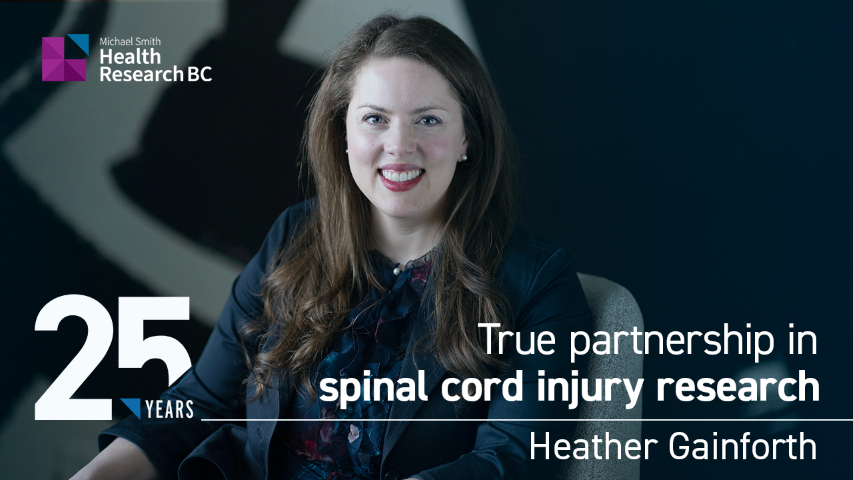
Dr. Heather Gainforth led a partnership that set out to change that. With support from Michael Smith Health Research BC, she sought to improve how spinal cord injury research is done, by shifting focus towards respectful, collaborative partnerships with the community.
“The award was pivotal to my research career,” says Heather, a researcher at the University of British Columbia – Okanagan. “It gave me valuable time for partnered and engaged research.”
That time made a difference. Partnered research requires ongoing conversations, trust, and shared decision-making. Heather brought together a multidisciplinary team of researchers, clinicians, community organizations, funding agencies, and people with lived experience of spinal cord injury. Together, they developed integrated knowledge translation (IKT) guiding principles for conducting spinal cord injury research in partnership. These principles defined what strong collaboration looks like in spinal cord injury research.
The work did more than produce a set of principles. It is changing how research is designed and carried out, putting more emphasis on co-developing research with spinal cord injury communities. The principles help make research more relevant, respectful, and accessible to the people they aim to support.
The IKT guiding principles have been adopted by many researchers and organizations across Canada. They have been cited in academic literature, embedded into training programs, and used by researchers and community organizations to guide partnerships. Some funding agencies now recommend researchers use the principles in funding applications, and some community organizations require researchers to use the principles in order to partner with them.
“I’m very proud of this work,” says Heather. “We’ve changed researchers, we’ve changed community organizations, and we’ve even influenced funders.”
The impact of the IKT guiding principles has also reshaped Heather’s career. She is now Associate Director of Meaningful Engagement at ICORD, where she leads efforts to strengthen partnership practices across spinal cord injury research programs. Recently, Heather became the Tier 2 Canada Research Chair in Research Coproduction and Implementation Science, a national appointment that recognizes her as an emerging leader in her field. In this role, she continues to support and evaluate transformational changes in spinal cord injury research.
Reflecting on this trajectory, Heather emphasizes that early career support from Health Research BC made the difference.
“It was invaluable,” she says. “Without the award, I wouldn’t have had the time, space, or credibility to do this kind of work in a meaningful way. It truly launched my research career.”
From addressing tokenism in spinal cord injury research to setting new expectations for how research is conducted and shared, Heather’s work shows how early investment can lead to a system-wide shift in partnership, training, and practice.
Learn more about the Integrated Knowledge Translation Guiding Principles.

Dr. Heather Gainforth
Dr. Heather Gainforth is Associate Professor in the School of Health and Exercise Sciences in the Faculty of Health and Social Development and Director at the Centre for Health Behaviour Change, both at the University of British Columbia – Okanagan (UBCO). She is also Associate Director of Meaningful Engagement at ICORD and Tier 2 Canada Research Chair in Research Coproduction and Implementation Science. Heather’s research aims to close the gap between health behaviour change research and practice by examining knowledge translation – the act of moving research evidence into the hands of research users.
She has trained and mentored the following Health Research BC-funded researchers:
- Femke Hoekstra, UBCO
- Alanna Shwed, UBCO
Stay informed
Subscribe to our newsletter and follow us on LinkedIn and Bluesky.