Health research changes lives when it’s put into clinical practice.
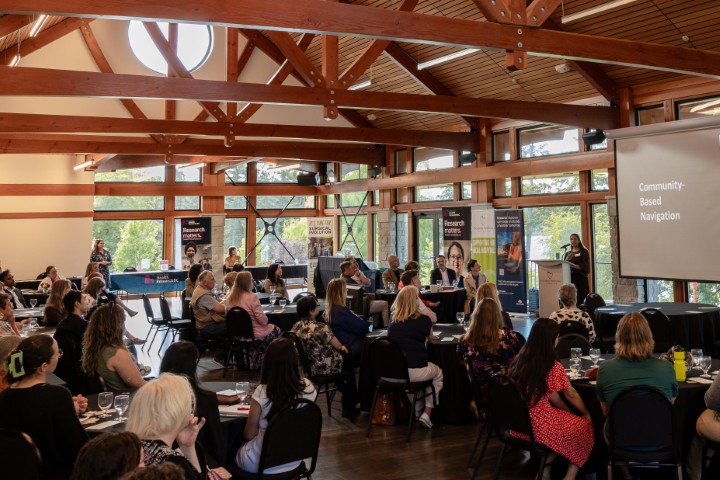
That was the common thread running through the recent Evidence to Impact Implementation Café hosted by Fraser Health. The event showcased several projects that are turning evidence into better care across BC with support from Fraser Health’s 2025 Knowledge Translation Challenge program.
Co-funded by Michael Smith Health Research BC with Surrey Hospitals Foundation, Peace Arch Hospital Foundation, and Fraser Valley Health Care Foundation, the 2025 Knowledge Translation Challenge shows how research can make a tangible difference when researchers, healthcare providers, decision-makers, and people with lived experience work together.
The power of partnership stood out across every presentation at the event. People with experience of different health conditions worked with researchers as partners to help shape research questions, co-lead projects, and guide implementation so that work focused on improving healthcare.
The next cohort of supported teams through the Fraser Health Knowledge Translation Challenge have already begun work to improve wound care, hospital discharge, dementia programming, and more.
Making pelvic exams more comfortable
One team shared their work to reduce pain and anxiety during pelvic exams. They co-designed training and resources developed alongside lived experience partners, including realistic vulvar models, to demonstrate what happens during an exam and put everyone in the room at ease.
“So many people who’ve experienced a vaginal exam might endorse it as painful,” says physiotherapist and primary investigator Jessica Adaszynski, who focuses on pelvic health. “Some individuals might not have actually experienced pain, but fear of it happening can cause distress.”
Melanie Chow has experience living with and overcoming chronic pelvic pain. She supported the project as a lived experience partner and data analyst. She shared how pelvic exams leading up to the birth of her first child were stressful, and that working to improve the experience for others is important to her.
“If the provider I was getting care from had experience working with someone like me, that made me more comfortable,” she says.
Providing reassurance when a loved one is in the intensive care unit
Another team made intensive care unit (ICU) stays easier for relatives with a handout to easily explain what loved ones are going through. Fiona Howarth, a critical care nurse specialist, worked alongside Lorne Player, who has stayed in the ICU before. They say spoken explanations may not be easily remembered during highly stressful times. Plain language visual handouts gave families reassurance and let them focus on supporting their loved one.
“Providing families with clear and reliable information is fundamental to improving their experience,” Fiona says.
Preventing bone breaks
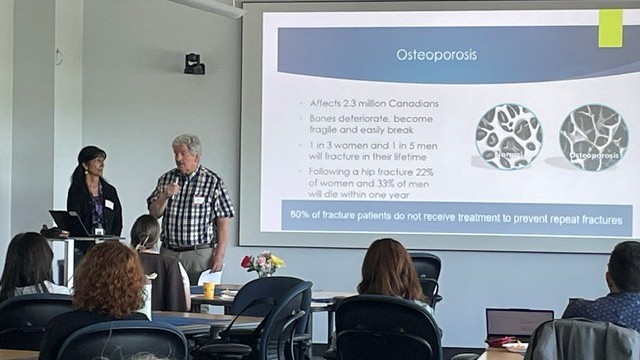
Attendees also heard from Health Research BC awardee Dr. Sonia Singh, a hospital-based physician, and Larry Funnell, who lives with osteoporosis – a health condition that makes a person’s bones weak. Their team is working to close the osteoporosis care gap through Fracture Liaison Services, a model of care that helps prevent future bone breaks.
Larry shared how he began breaking bones in his 40s, with each fracture bringing pain and lengthy healing periods.
“Although the fractures themselves received excellent treatment, the underlying cause of the broken bones went unnoticed and untreated,” he says.
That’s where Fracture Liaison Services come in, to identify people with low-trauma bone breaks to develop a personalized treatment plan with them focused on preventing future fractures.
Sonia and her team led implementation of the first Fracture Liaison Service in BC at Peace Arch Hospital in White Rock, with support from Peace Arch Hospital Foundation. Implementation science research supported the idea of new Fracture Liaison Services at other hospitals in BC. Fracture Liaison Services now operate at Surrey Memorial Hospital and Chilliwack General Hospital in Fraser Health, and Richmond Hospital in Vancouver Coastal Health.
The next step is integrating Fracture Liaison Services into routine bone break care across the province. Sonia’s team’s research estimates a provincial Fracture Liaison Service program could save $14 million over three years by averting hospital admissions due to recurrent fractures.
“I really want to highlight that what was novel when we started this work was involving patients as decision-makers,” Sonia said. “They were not just token members of our team – they’re involved in all aspects of research. They help us develop the research questions. They’re part of conducting the research. And of course, doing the knowledge dissemination.”