From strength to strength, modernizing funding approaches creates a stronger health research system and supports today’s talent.
Over the past 25 years, Health Research BC has supported more than 3,000 health researcher careers – substantially more if the mentorships, collaborations, and companies that benefited were also considered. As introduced in Built to last: Supporting health research talent, that sustained investment has helped the province build and retain the talent behind a thriving health research system.
This year, we concluded the salary awards program that anchored much of that investment. That decision deserves a deeper explanation — and the explanation begins not with what has gone wrong, but with how much has changed: in the strength of BC’s research system, in the pressures now reshaping it, and in what today’s researchers need to succeed.
Celebrating a stronger health research system
The success of our original mandate is visible not only in BC’s federal funding performance, but in the breadth and depth of the research and innovation ecosystem that has grown around it.
In BC’s life sciences sector, the number of businesses grew by 26.5% between 2018 and 2021, with larger companies — those with 50 or more employees — growing by 57% in that same period. Today, more than 2,000 life sciences companies employ over 20,000 people across more than 50 research centres.
Growing provincial reach
A significant and underappreciated dimension of this maturation is geographic. In 2001, the province’s health research capacity was concentrated in the Lower Mainland. Today, it exists throughout the province, with institutions outside Metro Vancouver competing nationally and attracting independent external investment.
The University of Northern British Columbia (UNBC) is one example. In 2024, UNBC recorded a 350% increase in funding from not-for-profit sources, including foundations and community organizations — a signal that external partners beyond federal granting agencies are investing in Northern BC research where a competitive advantage exists in addressing research priorities for rural and remote communities. In federal health research specifically, UNBC ranked first among universities in its tier for the proportion of total research income derived from the Canadian Institutes of Health Research (CIHR).
The new Stephens Family School of Medicine at Simon Fraser University welcomed its first class in 2026. Designed to advance primary care with research and community-centred partnerships as core components, the school’s faculty secured CIHR Project Grant funding — spanning primary care workforce, long-term care, and rural health equity — before its first graduates even started training.
This expansion has limits. The 2024 Life Sciences BC Labour Market Study found that the province’s life sciences sector remains largely concentrated in the Lower Mainland and Vancouver Island, with activity in the Interior and Northern BC still at early stages. But the direction is clear and has important implications for designing how provincial talent support going forward.
A program built around the assumptions of 2001 — Vancouver as a single dominant research hub, a linear academic career path, and a narrow federal competitiveness mandate — cannot serve a province where health research now happens from Prince George to Victoria, across health authorities, industry partners, First Nations, Métis, and Inuit-led communities and organizations, and a growing number of roles that did not exist 25 years ago.
A system under pressure
As with any complex system, the health research system does not exist in isolation. It is shaped by the institutions, funding structures, and social conditions that surround it — and several of those are under significant and concurrent strain.
University enrollment contraction
Universities across BC and Canada are facing a sharp contraction in international enrollment, driven in large part by federal restrictions on international student visas. Ottawa introduced a cap on study permits beginning in 2024, initially targeting a 35% reduction, with a further 10% cut in 2025 that — for the first time — extended to master’s and doctoral students. Study permit approvals fell by approximately 45% in 2024 compared to 2023. In the 2026 federal budget, the government further reduced international study permit targets by 49%, though graduate students were ultimately exempted from the new cap following advocacy from research-intensive universities.
The financial consequences for BC institutions are significant: international tuition has long subsidized domestic programs, and post-secondary institutions across the province are projecting deficits. The downstream effects on health research are direct. Universities rely on international graduate students’ research contributions, and a sustained reduction in graduate enrolment puts pressure on research capacity, lab staffing, and the talent pipeline that health research depends on. It remains unclear whether the province’s commissioned 2025 independent review of the public post-secondary education system will result in actionable recommendations to support long-term sustainability.
Fiscal pressure on BC’s health system
BC’s health system is navigating fiscal scrutiny that is reshaping how health authorities operate. In March 2025, the BC Ministry of Health launched a formal efficiency review of all health authorities, with a mandate to redirect resources toward “critical patient services” and eliminate administrative costs. Hiring freezes on non-clinical managerial positions, departmental restructuring, and layoffs of non-clinical staff have followed. For health researchers whose work depends on the health system — access to data, clinical settings, patient recruitment, and decision-maker engagement — this creates uncertainty. It also raises the stakes. Research that cannot demonstrate tangible and proximate value to a system under strain will face growing scrutiny for approval.
Fiscal pressures on research funding
The most direct pressure for health research sits closest to home. Over the past 25 years, the demand for health research support has grown, as has the cost of sustaining it. Salaries, infrastructure costs, and the scope of what competitive support requires have all risen. Health Research BC’s core provincial funding, however, has remained largely constant year over year. This creates an unsustainable trajectory for multi-year salary award programs. Sustaining them without long-term committed funds — and without a realistic path to growth — requires either reducing award values or reducing the number of awards made. Neither option serves BC’s research community well.
Changing career paths
Alongside these pressures, the career landscape for health researchers has shifted fundamentally. The traditional arc — graduate program to postdoctoral fellowship to faculty position to independent research program — is no longer the dominant trajectory for doctoral graduates in Canada.
A national cohort study tracking 20 years of PhD graduates from Canadian health services and policy research programs found that today’s graduates are more likely to enter a wider variety of sectors and roles and are less likely to be employed in academia than graduates from earlier cohorts. The Council of Canadian Academies has documented that structural mismatch: the path to the professoriate is now available to fewer people, while meaningful non-academic roles have not materialized fast enough to fill that gap.
At the same time, the definition of health researcher has expanded. Talented people trained in health research now work across industry, government, health systems, and community organizations. A 2024 analysis by the University of Toronto found that 9% more PhD life sciences graduates from the 2016–2021 cohort are working in the private sector compared to graduates from before 2016. The skills, and the impact that define a successful health researcher, are evolving – and so too must the programs that enable their success.
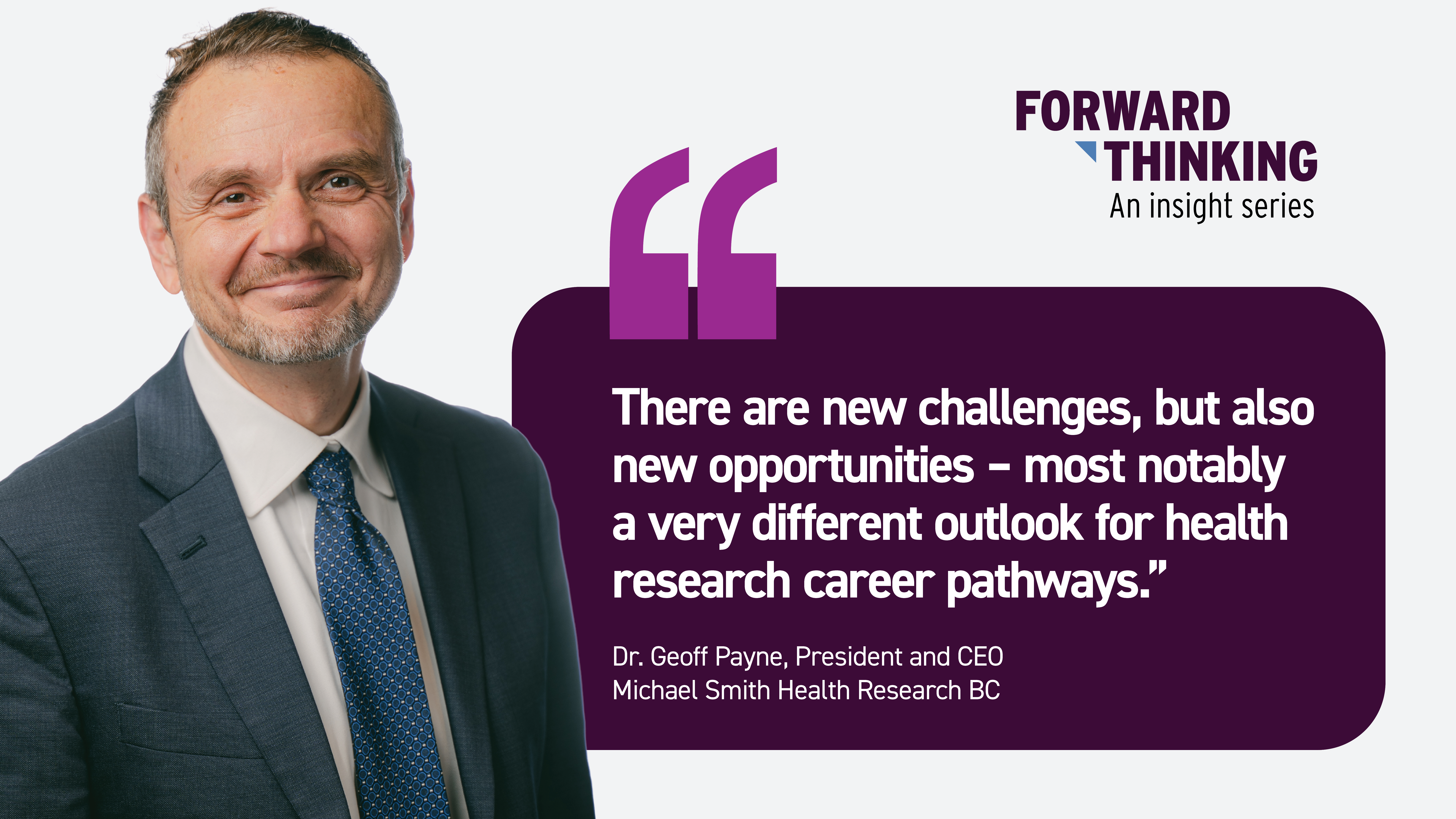
Modernizing for the future
Salary awards, as originally designed, were built for the older model: a linear career path centred on academic independence and the pursuit of peer-reviewed grants. That model assumed a specific destination — the tenure-track faculty position — and a clear measure of success — federal grant capture. Both assumptions now describe a narrower slice of reality than they once did. A one-size-fits-all approach also fails to account for the range of environments where health researchers now work — from bench science to bedside care, to policy, industry, and community settings across the province — and what constitutes meaningful impact in each context.
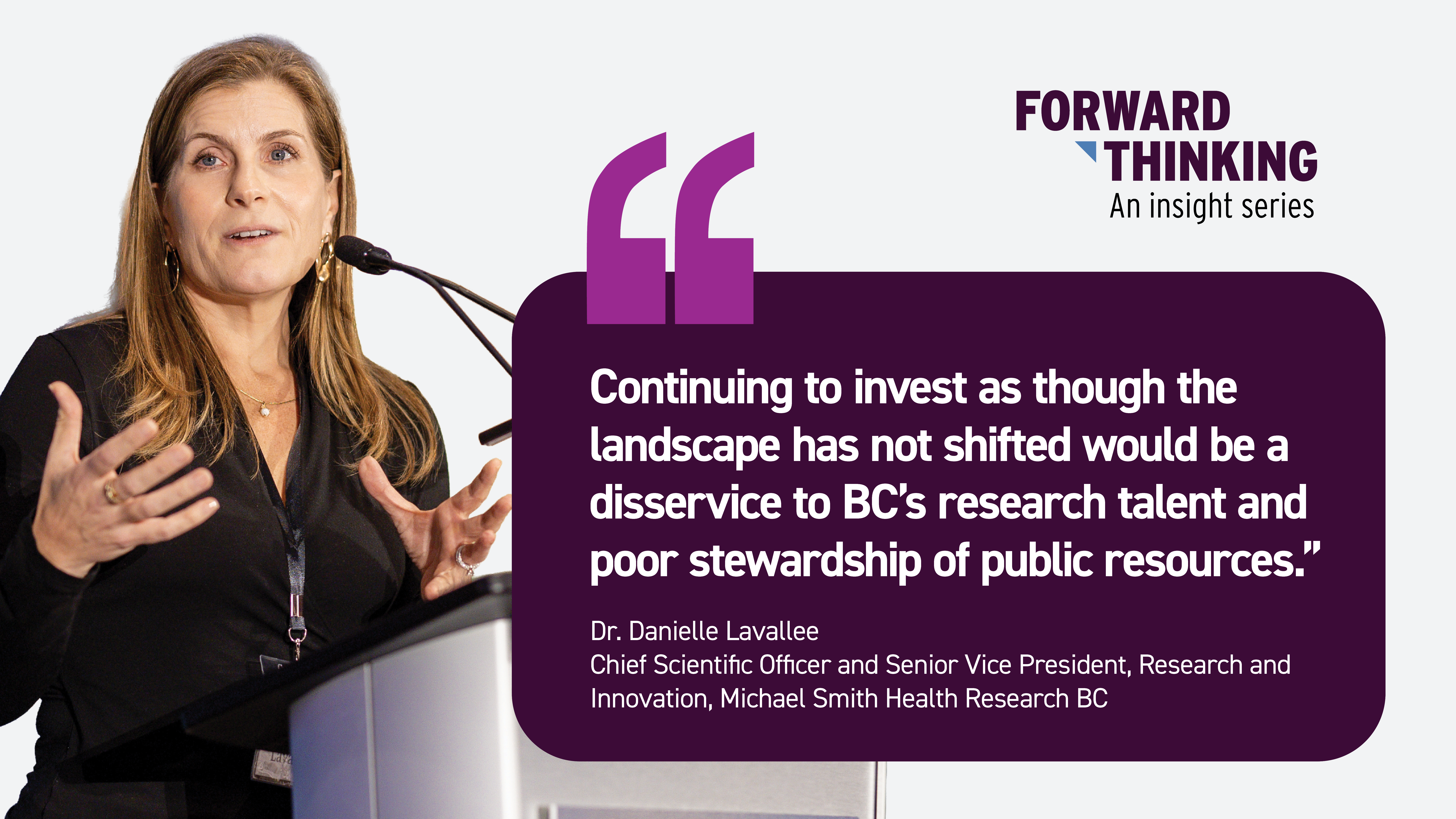
The founding investment logic addressed the challenge of its time: BC was losing the research talent to compete, and targeted salary awards would help close that gap and serve to attract new talent to the province. That deficit no longer solely defines BC’s situation. Continuing to invest as though the landscape has not shifted would be a disservice to BC’s research talent and poor stewardship of public resources. The conclusion of our salary award programs was a deliberate decision to design for a different and more sustainable future.
What comes next
Health Research BC is reviewing its research investment strategy, guided by the same commitment that has shaped our work since 2001: to support the health researchers and research that improve the health of people in BC.
Three principles are guiding that redesign. Flexibility: supports must reflect the many career paths health researchers now follow — in academia, health systems, industry, government, and community settings. Reach: programs must serve a research ecosystem that now extends across the province. Sustainability: what we build must endure within the funding realities we can count on, so that commitments made are commitments kept.
To those directly affected: we remain fully committed to the over 300 current award holders and to those whose applications are under review. We are working towards a more sustainable and responsive approach to supporting talent that reflects how BC’s research ecosystem has matured, how career paths have changed, and how the research enterprise itself is being transformed.
Our focus remains grounded in the spirit of our founding namesake – Dr. Michael Smith: you cannot have great science without great talent. And you cannot have great talent without collaboration – the research community working together to move from strength to strength. Health Research BC is committed to engaging with the health research system and moving towards new opportunities for dialogue and funding in the fall of 2026.
Forward Thinking is an insight series sharing experienced perspectives on the future of health research. We invite leaders and practitioners from across the sector to share their vision, lessons learned, and perspectives for what comes next.
Stay informed
Subscribe to our newsletter and follow us on LinkedIn for more updates.