
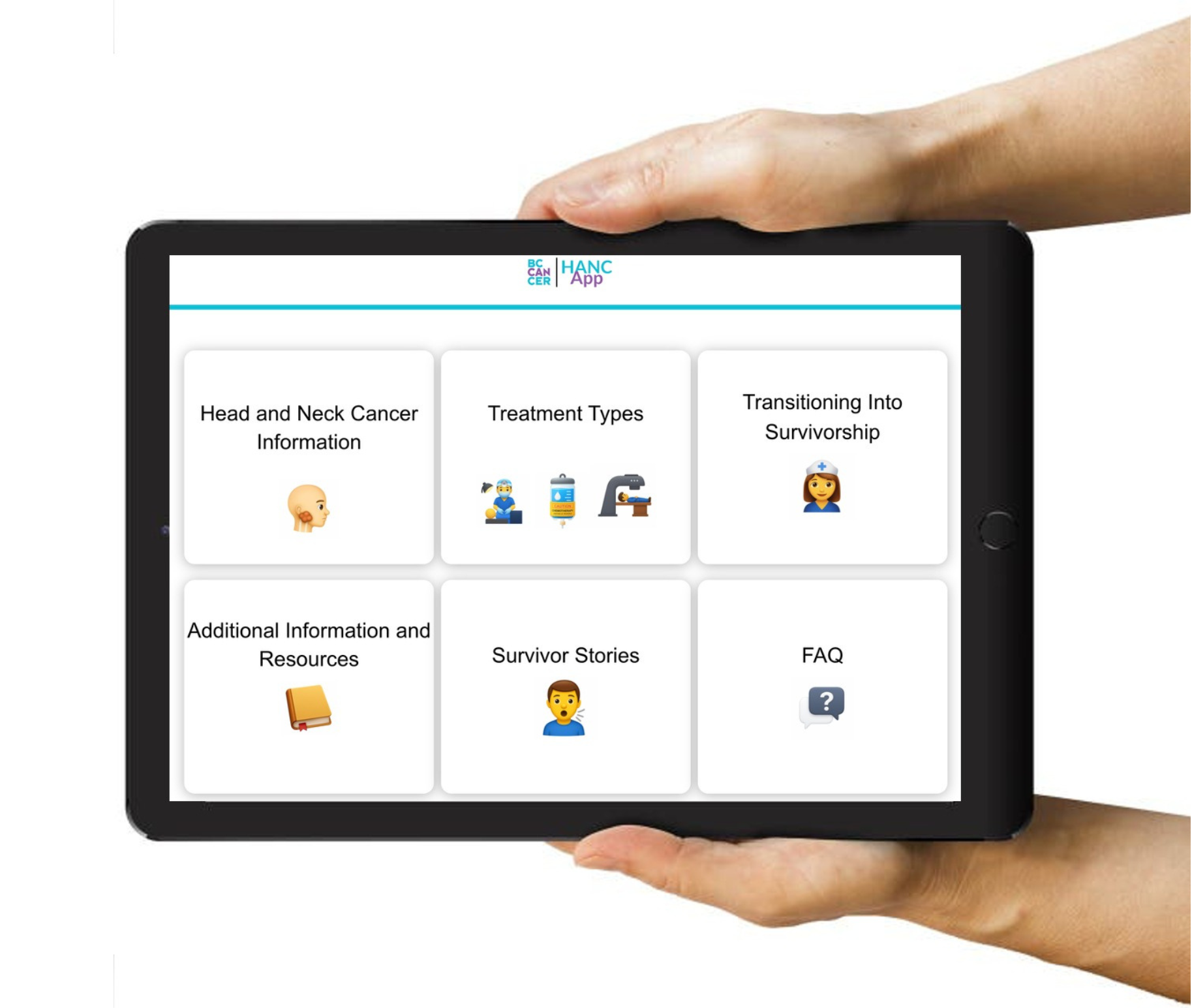
Above: Screenshot of the HANC App home screen.
This casebook project is one of many featured in the community and lived experience in research road map resource, developed by the BC SUPPORT Unit. Explore the full set of case study examples.
The Head and Neck Application for Patients and their Partners (HANC APP) study
Project team members include:
- Principal Investigator: Jonathan Livergant
- Team Members: Eleah Stringer, Lily Hallett Rio, Eitan Prisman, AnneMarie Cayer, Sally Smith, Andre Kushniruk, and Elizabeth Borycki
What is this project about?
It aims to help people with head and neck cancer make fully informed decisions about their treatment options. We are designing, building, and testing an innovative app (the HANC APP) to better meet patient information needs and to improve care for patients with head and neck cancer.
Survivors of head and neck cancer are involved through the entire design process. The app’s usefulness with be tested with patients and oncologists.
Who did you partner with for your project?
This study uses co-design methodologies with eight dedicated survivors of head and neck cancer.
How did partners with lived experience contribute during key stages of your research project?
Research stage
Research priority setting
How we partnered
This program of research began as Eleah’s Master’s thesis at the University of Victoria, where they conducted interviews with survivors of head and neck cancer to determine information needs and display preferences for the app.
This research was generously sponsored by a SPOR fellowship.
Research stage
Data collection
How we partnered
The HANC APP is being developed through co-design workshops that involve the University of Victoria “tech team” and our group of eight cancer survivors.
Their recommendations have directed every aspect of the HANC APP, including the content, design, and level of detail.
What’s your advice for someone who wants to collaborate with partners with lived experience?
Focus groups or workshops can be an effective way to involve multiple patient or public partners, allowing for diversity of perspectives. There is something so special about bringing everyone together in real time to tackle a problem together.
A shared vision is powerful for bring people together — it’s very true that “the whole is greater than the sum of its parts.”
How can someone learn more about your project?
Acknowledgments and thanks
- University of Victoria
- BC Cancer
This project was collected as part of a casebook that demonstrates patient-oriented research in BC.
Explore the casebook